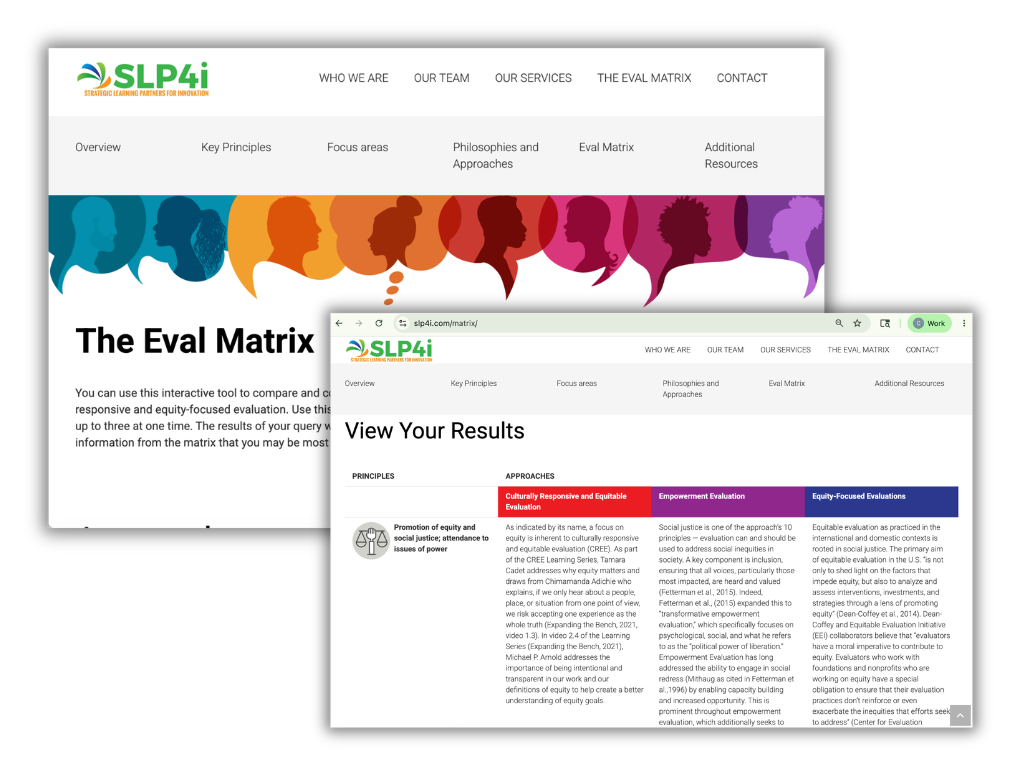
Seven Approaches to Culturally Responsive and Equity-Focused Evaluation — In One Place
If a funder has ever asked you to use a culturally responsive approach without being clear about what they mean, you are not alone. The terms around culturally responsive and equity-focused evaluations can be hard to navigate. Different words get used in different ways. And the differences between approaches are not always easy to explain in a proposal or a report.
The Eval Matrix is a free tool that can help.
What it is
Katrina L. Bledsoe and Blanca Guillen-Woods of Strategic Learning Partners for Innovation, together with Felisa Gonzales of The Colorado Trust, built an online matrix that maps out seven evaluation approaches that center culture and equity. Anchored by seven principles, it tells you what each one is, where it came from, what makes it unique, and how it applies in practice.
The seven approaches are laid out clearly. Each one gets a plain description with enough detail to help you decide which approach fits a specific project. The matrix is interactive — you can compare approaches side by side and see how they differ on specific principles. There is also an annotated reading list and other support materials that go deeper into each one.
Why it matters for small proximate evaluation firms
This tool is useful in a few specific ways. It gives you language to describe your approach in proposals. It helps you make the case to funders for why a specific method fits their unique context. And it supports the idea that culturally responsive and equity-focused evaluation is not a vague promise — it is a set of distinct, well-documented practices with real histories and foundations.
When funders ask for culturally responsive and equity-focused evaluations, this matrix helps you show them exactly what that means and why your approach fits.